|
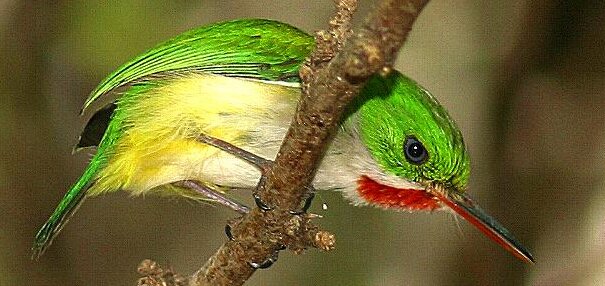
Above is a little Puerto Rican Tody, locally called 'San Pedrito'. Tiny little birds they travel through the woods in twos, chirping to each other as they go from branch to branch, in sight of each other or in hearing distance. Photos above and below were taken by Father Sanchez and he is kind enought to share them. See many many more wonderful bird photos on his websit
|
"Two families of birds are endemic to the West Indies, specifically to the Greater Antilles. One of them is composed by the todies (Todidae.) These are small, chunky-looking birds that superficially resemble hummingbirds. However, their closest relatives are kingfishers, with whom they share certain anatomical and behavioral traits. Both groups are placed in the order Coraciiformes.
All five species of todies are bright emerald-green above and have a scarlet-red throat. Their breasts, flanks, and bellies show different colors - combinations of gray, pink, yellow, blue - depending on the species. Their nests consist of burrows with terminal chambers, excavated in earthen banks in both xeric and mesic forests. The family was not always endemic to the Antilles, and it is a relict taxon: all that is left of a formerly more abundant and widespread group. There are fossil records of todids from North America where, in fact, they probably evolved. Only Hispaniola has two species. The other three are found, one each, in Cuba, Jamaica, and Puerto Rico. Together, extant todies comprise a single superspecies.
Todies are voracious animals that are almost exclusively insectivorous. Their constant activity and prodigious appetites force them to consume one insect almost every minute of the daytime hours. Their usual hunting technique consists of sallying out from a perch, capture an insect located on a leaf, twig, or in mid-air, and land on another perch, all in one neat, graceful movement. Like hummingbirds, when they cannot feed (at night or during prolonged periods of heavy rain) todies lower their metabolisms and temperatures to conserve energy.
Their habit of sitting motionless between sallies to catch an insect make them difficult to detect visually amongst the foliage. They are far easier to hear than to see, although they are not precisely distinguished for their vocal abilities. Their raspy and monotonous "neeet" or "prrrrrrreeet" calls and the rattling sound made with their wings during their short flights give away their presence. Extremely tame creatures that they are, they will often allow a human to approach them within a couple of meters. " Father Sanchez.
|
Father Sanchez Nature Website
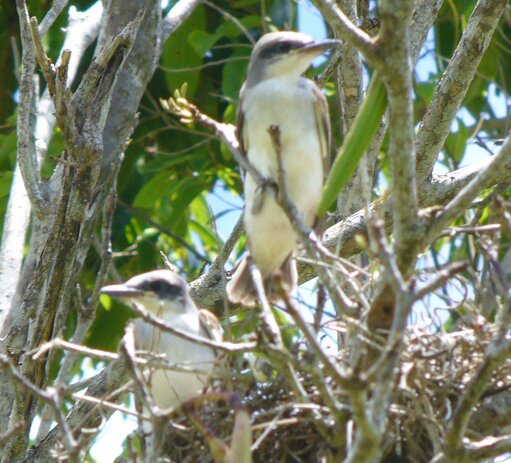
Pitirre Nest with two young birds. Endemic 'Puerto Rican Flycatchers'. Photo: Elena
Another good resource for birdging in PR 'Field Guides'
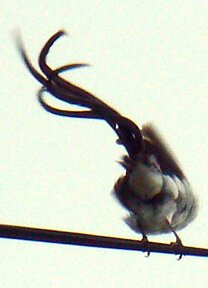
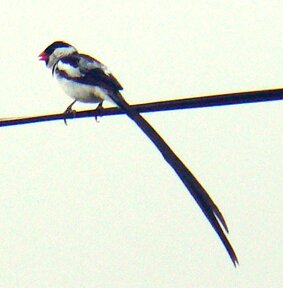
A male Pin-tailed Whydah (Viuda Colicinta) almost in full breeding plumage,
( introduced to Puerto Rico in the 1950's. )
Mangrove Cuckoos, Vieques, in Bayahonda Trees.
Elenas Photos of Mangrove Cuckoos
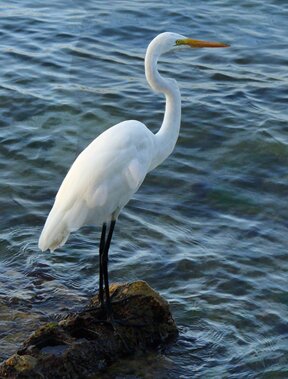
Great White Egret, fairly common. Photo Elena
A wonderful website of bird photos in a bird 'journal' (not Puerto Rico)
" Laguna Cartagena National Wildlife Refuge "
There are 17 endemic species of birds in Puerto Rico and many other birds that stop on the island on their migration routes.
The endangered species Puerto Rican Parrot (amazona vitatta) below right lives only in a few hidden areas of the El Yunque National Forest. There are presently approximately 170 birds alive, but only about 60 in the wild. Figure is up from about 11-16 birds in 1968 see article on the El Yunque News pages.
Father Sanchez has the most wonderful website full of great bird photos ( and much more). This link will open in a new window. Click on AVIAN on the left guide bar for bird photos.
|